Clara LindenPublished November 10, 2026
The 28-Day Grabovoi Code Plan for SleepA Night-by-Night Routine for Calm and Rest
A four-week, night-by-night practice that gives bedtime attention one small task and then lets it end. Prepare, focus, release, with no belief in numbers required and no uneventful evening treated as a failure.
An educational, reflective practice. Not medical treatment, and not a reason to change or delay care.
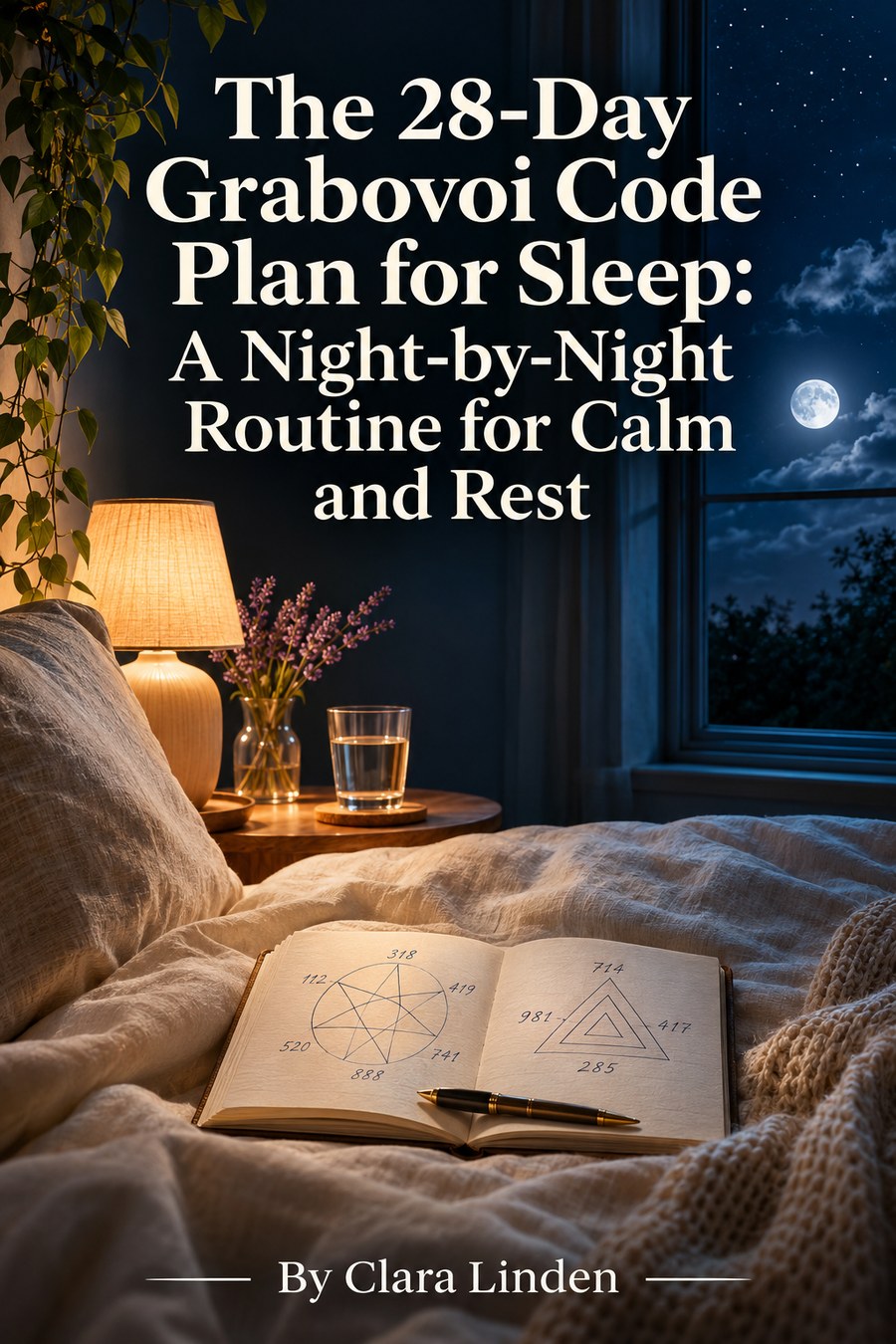
What the book explores
One small task, ended on purpose, repeated for four weeks
The plan is deliberately narrow. Each part below is described in the book’s own listing, and each one exists to keep the practice from becoming one more thing to get right at bedtime.
- 01
A three-part frame: prepare, focus, release
Every session has a beginning, a middle and a deliberate ending. Preparing sets the scene, a number sequence becomes the one object of attention, and the session is closed on purpose rather than trailing off.
- 02
Three ordinary nights before Day 1
The plan begins with a baseline: a few unremarkable nights recorded before any practice starts, so later weeks have something real to compare themselves against.
- 03
Four weeks, one steady focus
Week one stays near five minutes. Later weeks add a longer focus period, a slow visualization pass, and a short prepared response for waking at night.
- 04
A routine you are allowed to shorten
The book repeats one instruction: simplify, shorten or stop when a practice starts to create tension. Returning to the routine matters more than producing a result.
- 05
Nights that do not go to plan
Troubleshooting covers restlessness, missed sessions, travel, disrupted schedules, doubt, and the urge to keep switching to a stronger sequence.
- 06
The boundaries, stated plainly
The book separates practitioners’ claims from demonstrated effects, considers ordinary explanations for perceived change, and says there is no reliable scientific evidence that a sequence acts as a sleep aid.
The perspective it takes
Why a reader would choose this approach
When bedtime becomes another task to get right, even a calming routine can start to feel like pressure. The book answers that pressure by narrowing the task until it is small enough to finish in a few minutes, and by keeping the focus stable rather than hunting for a stronger code each evening.
It also treats the reader as an observer. Nothing in the plan depends on an evening going well, and the weekly reviews are written to notice how the routine fits a life, not to score it.
Where the book draws its limitsAttention, not sleep, is the object
The nightly task is to give attention somewhere to rest for a few minutes and then end it. Sleep is observed, not demanded.
Observation instead of scoring
Weekly reviews ask whether the starting cue was easy to use, whether visualization felt comfortable, and whether waking felt less troubling, rather than “did the numbers work?”
Honesty about what numbers can show
Personal notes are treated as information, not proof of numerical effects. Other changes, from stress to caffeine to screens, are considered alongside them.
Who it is for
Readers this plan is written for
You have tried bedtime routines that turned into another task to get right, and you want one with a clear end.
You are curious about Grabovoi number sequences and want a reflective, plainly bounded introduction rather than a promise of results.
You want a structured way to observe your own evenings: a baseline, nightly notes and weekly reviews.
You prefer a practice that states its limits, including when persistent sleep problems call for professional help.
The book is not a treatment for insomnia and does not replace clinical care. It also names the point at which persistent sleep difficulties, breathing-related warning signs or significant daytime sleepiness call for professional help.
Reader questions
Questions readers ask before starting
What does Clara Linden mean by prepare, focus, release?
It is the book’s three-part session structure: prepare the setting and the sequence you have chosen, focus on that sequence as a single object of attention, then end the session deliberately so it does not drift into more effort.
Does the plan require belief in special number powers?
No. The book states that you do not need to believe in special numerical powers to follow the practice, and it does not ask you to treat the sequence as medically effective.
What supplies does the routine use?
A sequence card, a notebook or log pages, and dim lighting. The book does not require ceremonial supplies, and it does not present any sequence as a treatment.
How does the 28 days begin?
You gather the small kit, record where your chosen sequence came from, pick a flexible starting window, and observe three ordinary nights as a baseline before Day 1.
Can the nightly routine be shortened?
Yes. The book explicitly permits shortening, simplifying or stopping the practice when it adds strain, including during the longer focus period in week two.
Do sleep journal changes prove that Grabovoi codes work?
The book’s answer is no. Personal observations are treated as information about how a routine fits your life, not as evidence that number sequences caused a change.
Book and author details
The exact edition
Every link on this site opens the same Amazon listing. Current editions, formats and availability are shown there.
- Title
- The 28-Day Grabovoi Code Plan for Sleep: A Night-by-Night Routine for Calm and Rest
- Author
- Clara Linden
- Published
- November 10, 2026
- ASIN
- B0HR45HB9R
- Listing
- amazon.com/dp/B0HR45HB9R
Start with one evening
Twenty-eight nights, one small task at a time
If the idea of a bedtime routine that ends on purpose sounds more workable than one that demands a result, the book’s four-week structure is the place to begin.
Opens the book’s Amazon listing. No purchase happens on this site.